
 flag history
Sep 19, 2026
3 min read
Why Romania and Chad have almost identical flags
Read story
From royal crosses and revolutionary stripes to stars mapped from the night sky, discover the stories behind the flags of Britain, the United States, Japan, Brazil, and Türkiye.
By Flag Trivia
9 min read

A flag is a small piece of visual language. Its colors, geometry, and symbols can point to a revolution, a royal union, a landscape, a constellation, or an idea about national identity. That is why learning flags is more than memorizing patterns: it is a fast and surprisingly vivid route into world history.
The most recognizable flags usually succeed in two ways at once. They are simple enough to identify from a distance, yet meaningful enough to reward a closer look. A stripe can preserve the memory of a political movement. A star can count states or map the sky. A cross can show how neighboring countries share a tradition while telling separate stories.
In this guide, we will look at five famous flags and the historical details hidden in their designs. If you are new to the world of flags, keep the flag quiz open as you read, or browse the complete flag legend to compare the designs.

The Union Jack is not a single ancient symbol. It is a layered design built as the political unions of the United Kingdom developed. The first Union Flag appeared in 1606, combining the red cross of Saint George, associated with England, and the white saltire of Saint Andrew, associated with Scotland. When Great Britain and Ireland were united in 1801, the red saltire of Saint Patrick was added, creating the design familiar today.
That history is visible in the geometry. The broad red cross belongs to Saint George, the white diagonal cross belongs to Saint Andrew, and the narrow red diagonal cross represents Saint Patrick. The diagonal elements are deliberately arranged asymmetrically, so the flag is not simply a set of perfectly stacked lines. This detail is useful when identifying the flag and reflects the way its component symbols were combined.
You may hear both “Union Jack” and “Union Flag.” “Union Flag” is the safest general term. “Union Jack” became especially associated with flags flown at sea, although it is now widely used in ordinary conversation as well. The design traveled around the world through naval power, trade, migration, and empire, which is one reason it remains familiar far beyond the United Kingdom.
The Union Jack also became part of the visual history of other countries. Australia, New Zealand, and Fiji, among others, retain it in their own flags because of historical connections with Britain. In those flags, the small canton is not just a decorative corner: it is a clue to a particular political past.
Flag clue: look for three overlapping crosses, including a diagonal red saltire edged in white. The combination is more distinctive than the individual colors.
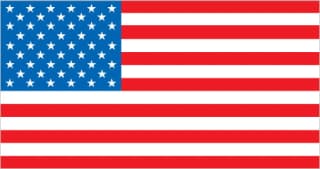
The United States flag is built around a clear historical formula: thirteen alternating red and white stripes for the original colonies, plus a blue canton containing a star for each state. The number of stars has changed as new states joined the union, while the thirteen stripes have remained fixed. That gives the flag an unusual quality: it records political growth without abandoning its founding reference.
The modern fifty-star arrangement was adopted after Hawaii became a state in 1959 and first flew officially on July 4, 1960. Earlier versions had fewer stars, arranged in different patterns. Looking at those historic flags is like looking at a visual timeline of the country’s expansion.
The flag’s colors are also interpreted through American tradition. In the Great Seal’s symbolism, red is associated with valor, white with purity and innocence, and blue with vigilance, perseverance, and justice. Those meanings are part of the United States’ own story; they should not be treated as a universal dictionary for every red, white, and blue flag.
The flag has also accumulated stories that are not quite the same as its documented history. The familiar tale that Betsy Ross designed the first American flag is deeply embedded in popular culture, but historians have not found conclusive evidence for that claim. The broader lesson is useful: flags live both in archives and in public memory, and those two histories do not always line up perfectly.
Flag clue: count the stripes only when the image is clear, then look for the blue canton. The stars tell you the current number of states; the stripes point back to the original thirteen colonies.

Japan’s flag is often called the Hinomaru, meaning “circle of the sun.” A red disc sits on a white field, producing one of the world’s most economical national designs. There are no stripes, border, coat of arms, or lettering to distract from the central emblem. In a single glance, the flag presents the sun as its entire visual focus.
The sun has deep associations in Japanese history and culture. Japan is often described as the land of the rising sun, and the imperial household has long been connected with the sun goddess Amaterasu in traditional mythology. The flag’s meaning therefore reaches further back than its modern legal form, even though the exact design and its official use developed over time.
The red disc was formally standardized for use on ships in the nineteenth century, and the flag later became closely associated with the modern Japanese state. Its history also includes difficult wartime associations, which means the same symbol can evoke pride, heritage, or painful memory depending on context and personal experience. Understanding a famous flag does not require flattening those different responses into one simple definition.
Japan’s design is a good lesson in proportion. When a flag has only two colors and one shape, a small change in the disc’s size or position affects the entire composition. Simplicity is not the absence of design; it is design with nowhere to hide.
Flag clue: a centered red sun on a plain white field points to Japan. If the sun has rays or the background is different, you are looking at another flag or a historical variant.

Brazil’s flag combines a green field, a yellow diamond, a blue globe, and a white band carrying the words “Ordem e Progresso,” or “Order and Progress.” It is one of the world’s most detailed national flags, but its elements are arranged in a strong hierarchy: the diamond frames the globe, the globe contains the stars, and the band gives the eye a clean path across the design.
The current design was adopted soon after Brazil became a republic in 1889. The green and yellow were retained from earlier imperial symbolism, while the globe and stars introduced a new republican identity. The blue globe represents the sky over Rio de Janeiro on the morning of November 15, 1889, the date of the republic’s proclamation.
Brazil’s stars are not random decoration. The flag shows twenty-seven stars, representing the twenty-six states and the Federal District. Their positions are based on constellations, including the Southern Cross, and each star is associated with a particular federal unit. The result connects political geography with astronomy: the country is represented both as a federation and as a view of the heavens.
This makes Brazil especially rewarding to study. At a distance, the green and yellow diamond are enough to identify it. Up close, the globe invites questions about the country’s political structure, its capital-region history, and the night sky visible from its territory.
Flag clue: the yellow diamond inside a green field is already distinctive. The blue globe, white band, and dense arrangement of stars confirm Brazil.

Türkiye’s flag uses a vivid red field with a white crescent and five-pointed star. The open space around the emblem gives the design a strong silhouette, while the contrast between red and white keeps it recognizable when the flag is moving or viewed from far away.
The crescent and star have a long visual history in the region, but their meanings are not limited to one simple origin story. Crescent imagery appeared in older cultures and became strongly associated with Ottoman and later Turkish identity. The modern Turkish flag developed through that history and was standardized in the era of the Republic of Türkiye. It is more accurate to describe the design as an inherited and refined symbol than as an image invented at one single moment.
The flag’s red field is often connected with sacrifice, courage, and the historical experience of the Turkish nation. The crescent and star are widely recognized as symbols of national identity, and the crescent also has a prominent place in Islamic visual culture. Still, the meaning of a flag is shaped by context: official ceremonies, family traditions, sport, remembrance, and everyday civic life can all bring different associations to the same image.
Türkiye’s flag is also a useful comparison with other crescent-and-star flags. Several countries use related motifs, but their backgrounds, proportions, colors, and emblem placement differ. In a quiz, do not stop at “red, crescent, and star.” Check the direction and shape of the crescent, the star’s position, and whether the field contains any additional symbols.
Flag clue: a white crescent opening toward a five-pointed star on a plain red field is the signature combination.
These designs come from different political traditions, but they reveal several recurring principles of flag design:
If you are studying for a flag quiz, attach one image and one idea to each flag:
Every flag is an invitation to ask another question: where did this symbol come from, why were these colors chosen, and what changed along the way? Compare these designs in the flag legend, test what you remember in Flag Trivia, and return to the play page for another round.
Continue reading
More stories about the symbols, histories, and details behind the world's flags.

